




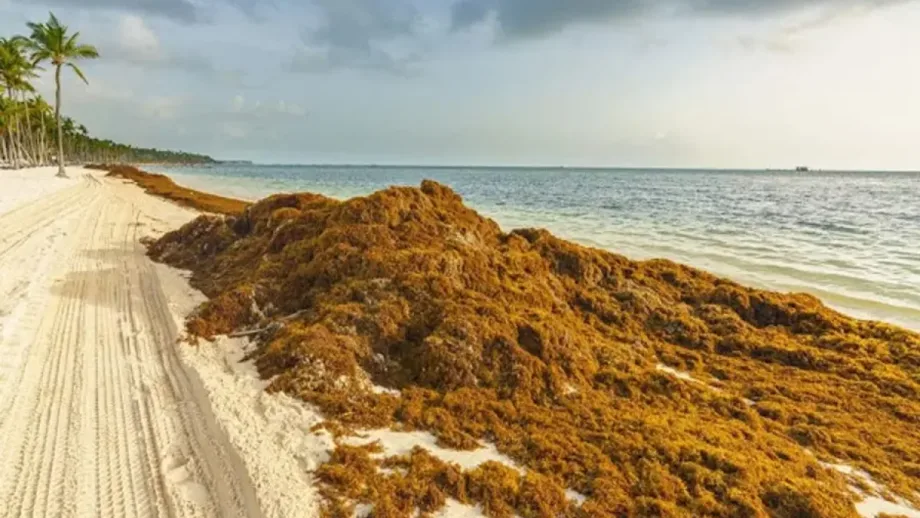
Santo Doming.- Dominican Republic and Mexico are working on a pilot plan to find solutions to the sargazo, which will begin in the coming months.
The initiative seeks to address together possible solutions to the problem, with non-refundable funds from the Inter-American Development Bank (IDB), which provides for the application of a dam system as an alternative.
This was reported by the Minister of Tourism, David Collado, during his participation in the Sustainability Forum. He explained that the country has funds to seek solutions; however, there is still no viable proposal to ensure that the arrival of these algae to the coast is stopped.
He recalled that, as part of the continuity of the State, he followed up on the plan of the previous President, Danilo Medina, to create a fund with public and private sector contributions to deal with the sargazo.
He noted that, on taking up the position of minister, he allocated $9 million to a fund to find solutions to this problem on the Dominican coast. This has a contribution of US $6 million from the private sector, as part of an agreement to finance initiatives to deal with the arrival of the sargazo to the beaches of the country.
He noted that the resources were deposited in an account in the name of the Dominican Republic Hotels and Tourism Association (Asonahons).
However, after consultations and participation in meetings in different Latin American countries, he found that there is still no final solution to that challenge. In that regard, resources remained unimplemented.
He stressed that sargazo is one of the environmental challenges facing Dominican tourism and that its approach requires cooperation between the State and the private sector.
Speaking about other sustainability initiatives that will help maintain the leadership of the tourism sector, he said they are preparing to start the bidding of a beach regeneration program, which provides for an investment of US $70 million and will start with the intervention of 11 coastal areas.
He indicated that sustainability goes beyond the environmental, as it also implies social impact and improved quality of life. To achieve that balance, a commitment and sacrifice from the public and private sectors is required.
He called for a sincere look beyond the cost of sustainable tourism, to also consider the cost of not being sustainable over time.
Colonial zone
The staff member revealed the date on which work in the Colonial Area will be completed, indicating that the work on street rehabilitation, housing recovery and infrastructure improvements in the Colonial City will be completed on December 15.
He recalled that the intervention seeks to make the Colonial City a sustainable, inclusive and inclusive space, through works that not only contribute to improving its tourist attraction, but also to the living conditions of its residents.
He stressed that the project includes the rehabilitation of streets, the laying of cables, the recovery of housing in conditions of deterioration and the conditioning of facades.
He indicated that, as part of the actions, more than 130 houses have already been painted, while another 130 houses have received interior conditioning and cleaning of their facades.
It highlighted the addition of four electric buses to facilitate the movement of tourists and residents through the Colonial City, in view of the difficulties of parking in the area.
"These vehicles were purchased from non-refundable funds from the European Union and the Inter-American Development Bank (IDB)," he said.