






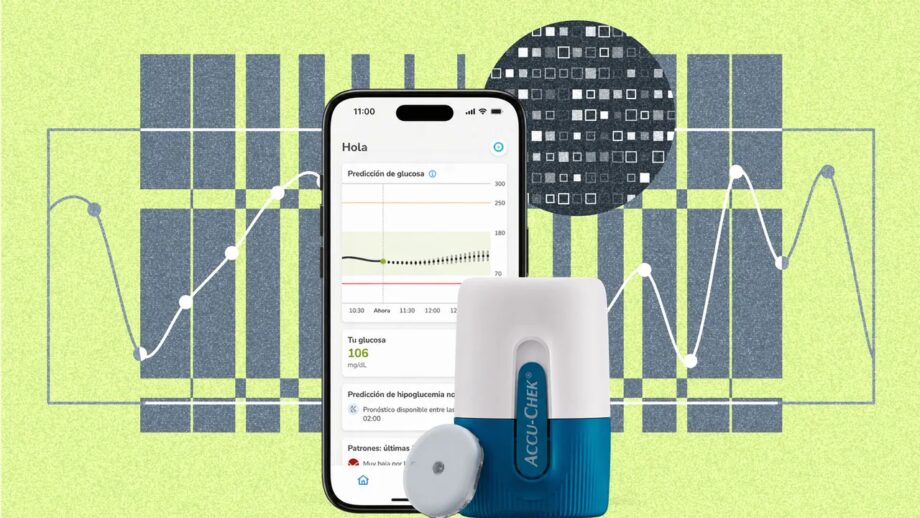
Before sleeping, a person with diabetes can consult a light on his cell phone that estimates the risk of his or her glucose levels falling for the next seven hours. The calculation is done by an artificial intelligence system (IA) that analyzes the data of a sensor placed on the arm. This technology began to be marketed in Mexico in September 2026.
This is Accu-Chek SmartGuide, developed by Roche for adults with type 1 or type 2 diabetes. In the country, it is estimated that 14.4 million adults lived with the latter disease between 2021 and 2024, according to the National Health and Nutrition Survey (Ensanut). For those who use insulin, one of the risks of treatment is hypoglycaemia, an excessive fall in glucose that may occur while they sleep and make it difficult to respond in time.
The continuous monitoring sensors are already several years old in Mexico. FreeStyle Free 2 Plus from Abbott allows to receive warnings when glucose reaches too high or low levels, while Guardian Connect from Medtronic introduced alerts about possible alterations up to an hour in advance. The new system adds a graph of how glucose could evolve over the next two hours and a specific estimate of the risk of night hypoglycaemia.
The first surgery trial by a humanoid robot has been a success
An American research team has for the first time successfully performed laparoscopic surgery on a pig using a humanoid robot. Although in some respects it has shown a performance comparable to that of specialized surgical care robots, a number of challenges have also been identified.
From measurement to prognosis
The device uses a sensor attached to the arm that measures glucose in the interstitial fluid, the fluid that surrounds the cells under the skin. Unlike conventional tests that require a drop of blood, Accu-Chek SmartGuide records the levels every five minutes and sends the information to the phone by Bluetooth.
The readings appear in the mySugr application, where data on food, physical activity and treatments can also be recorded. With this information, the system generates three types of predictions: a warning about possible glucose drops in the next 30 minutes, a projection of its evolution over two hours and an estimate of the risk of hypoglycaemia in the next seven hours of sleep.
“It helps us to anticipate our decisions when we live with diabetes, food decisions, physical activity, hydration decisions,” explains WIRED in Spanish Mariana Castellanos, leader of solutions strategy close to the patient of Roche Mexico.
For example, a person who is given an alert about a possible glucose drop can review their levels and follow the measures agreed with his or her doctor. The two-hour projection also allows to identify possible changes after eating or exercising. The night function, for its part, classifies the risk as normal, high or very high before the person is in bed.
For Castellanos, one of the motivations behind this technology is “the benefit that has to be able to anticipate the damage or even to a fatal moment.".
How reliable are the predictions?
Measuring glucose and anticipating its changes are two different aspects. A research published in 2024 in Journal of Diabetes Science and Technology showed that 99.8% of sensor readings were within the margin of error considered clinically acceptable.
To develop the predictive functions, Roche worked for approximately five years with IBM. Both companies developed trained algorithms with clinical records of people with diabetes, able to recognize patterns and use each user's glucose history to anticipate possible changes. As Mariana Castellanos explains, the IA “takes the patient's data, learns from the patient and emits predictions.”.