




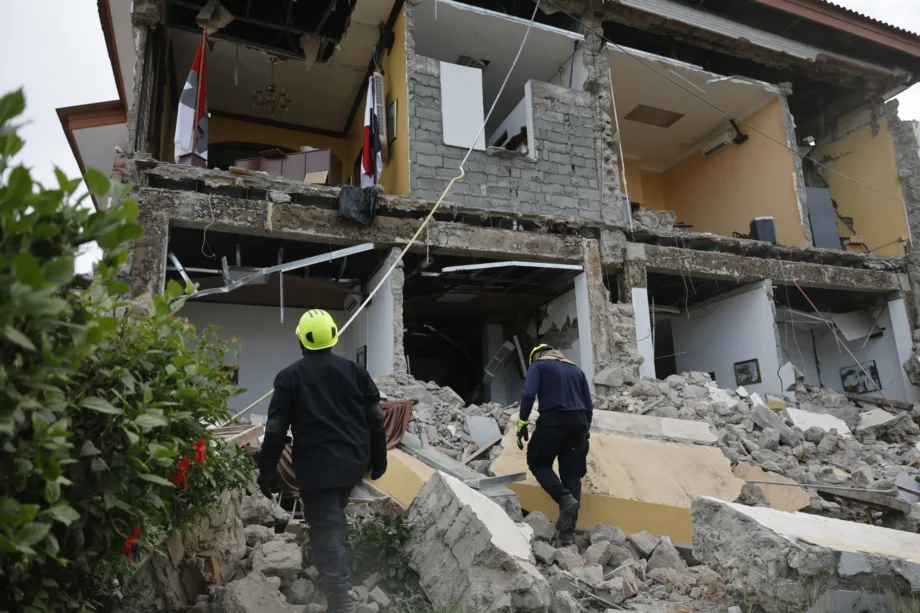
There is no water, nor light for more than 24 hours in Tonosí, the village closest to the epicenter of the magnitude 7.7 earthquake that occurred on Friday in Panama, which continues under constant replicas, hopping the neighbors, many of them now homeless.
What is in one of the parks is an improvised pot cooking on slow fire by three women, staff of the health center, who have been serving the three meals - breakfast, lunch and dinner - along this Saturday to the victims of the small town.
The premises of Tonosí line up for Argelis Ortega to give you something to eat in a disposable container. Some have lost their homes and many have fear within the body.
“There have been enough. Breakfast, lunch and dinner for more than a hundred people,“ says EWE Ortega while the pig is seasoned.
The park of that town away from the Pan American road, the main one that crosses Panama, has become a camp, dining room and improvised hospital at the same time since at 12: 56 local time Friday an earthquake of magnitude 7.7 - according to data from the United States Geological Service (USGS) - occurred near Tonosí, the nearest town to the epicenter.
The Institute of Geosciences of the University of Panama reduced the magnitude to 7.5.
The food was donated by the neighbors as local authorities distribute water and patients are located as they can under a couple of old awnings with anxiety pictures or blows by the falls at the time of the earthquake.
The main ways to reach this small town in southern Panama are damaged: a landslide has cut one of them and on the other there are cracks, fallen trees and stones, so the Executive has come by helicopter to assess damage.
Not to stop shaking
While medical personnel put the intravenous tracks and Ortega stirred the caldero, the earth kept shaking under his feet with more than a hundred replicas recorded since the Friday earthquake.
The neighbors are on plastic chairs, although the little ones sleep on mattresses. This is the case of Cristal Reyes, from Tonosí, who is kept in a circle with his family in the middle of the park trying to calm his children.
“I didn't even dare go to my house. He sent me a video (my husband) and it's all on the floor,“ he was talking to EFE when another replica forced the interview to stop.
Reyes works near that park and the medical center. When he started to tremble, he ran out but the magnitude was so great that he lay it down with his other companions.
Inconvenience and nervousness add to the constant replicas reported along this Saturday while waiting for the restoration of basic services.
The authorities of Panama have not yet given a number of material losses due to the earthquake, but have already declared a state of national emergency to channel up to $100 million to deal with the situation.
According to the most recent official report, the seismic event left 27 people injured, none of which were serious, affected to different degrees 426 housing units in which 2,130 people, 419 schools, as well as some roads inside.
The most affected area is the Azuero Peninsula, where Tonosí belongs, a arid region near the Pacific, characterized by small villages with a colonial style, an aged population and an economy dependent on the primary sector.
EFE found that the central squares of the villages have structural damage to their historic buildings, cordoned areas and neighbours pending the humanitarian aid that is being distributed.