





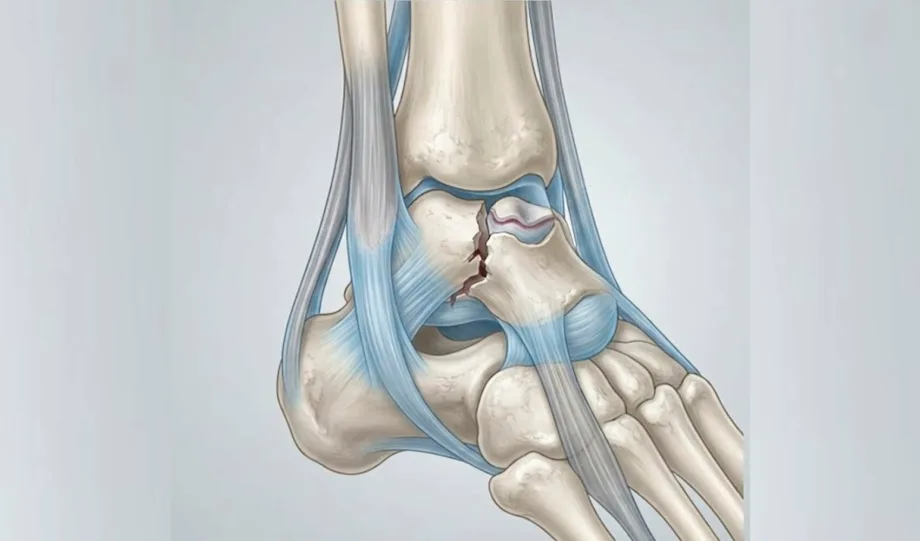
The astragalo injury is one of those ailments that help to understand how much elite football depends on small, but decisive, anatomical structures. A player can have strength, speed and an excellent physical condition, but if the bone that transmits the loads between the leg and foot is damaged, actions as usual as running, stopping, turning or hitting the ball can become a problem. The difficulty is not only in pain: certain astragal lesions affect a joint subject to constant requirement and may require months of recovery. Therefore, although it does not always receive as much public attention as a ligament break or muscle injury, its sporting importance is considerable.
The astragalo, also known as talus, is one of the central bones of the ankle. It is found between the tibia and the peroné, which form the lower leg, and the calcaneum, the main bone of the heel. Its function is to transmit body weight to the foot and facilitate the movements that allow you to walk, run, jump and change direction. Unlike other bones, a significant part of its surface is covered with joint cartilage, allowing it to slide in contact with the neighbouring bones. This particularity is essential for movement, but it also makes some injuries complex to treat.
Football subjects the astrogale to a particularly demanding job. Each acceleration, landing after a jump or sudden change of direction generates forces that cross the ankle. When the player supports the foot to turn, the joint must bear load and at the same time adapt to a quick movement. Contacts with other football players, unstable supports and twisting may increase the risk of injury. Repeated overload problems may also occur, especially when there is a previous injury, biomechanical alteration or incomplete recovery. It doesn't always take a spectacular blow to make the damage important.
A small bone, a recovery that can be long
Talking about an astragal injury does not mean referring to a single disease. It may be a fracture, a cartilage and bone injury below, a bone contusion or a change related to the supply of blood to the tissue. Each situation has different characteristics and forecasts. Some injuries can be handled with immobilization, discharge and rehabilitation; others need surgery. Therefore, there is no universal recovery time: gravity, location of damage, joint stability and individual response determine the treatment and time needed to recompete.
One of the reasons why these lesions can be delicate is the vascularization of the astragal. The bone receives blood through a network of vessels that can be compromised in certain fractures. When blood supply is significantly reduced, there is a risk of developing avascular necrosis, a process in which a part of the bone tissue is lost to viability. This complication does not appear in all cases, but may make recovery difficult and compromise the joint surface. In serious injuries, the problem is no longer simply to consolidate the bone: it is also necessary to preserve its structure and the function of the ankle.
Another relevant injury is osteocondral, which affects the cartilage of the joint and the bone located immediately below. It may appear after a twist or trauma and in some cases cause deep pain, inflammation, stiffness or a feeling of blockage. Their diagnosis is not always simple, because the discomfort can be confused with a common sprain and persist when the player hopes to have overcome the initial injury. If the damage is not adequately identified, premature return to training may aggravate symptoms or prolong the recovery process. The persistence of ankle pain therefore deserves professional evaluation.
In professional football, the main difficulty is that the ankle must respond to repeated and explosive movements without losing stability. It is not enough to walk without pain to consider that a player is ready to compete. A football player may tolerate daily activities and, however, may not be ready to make sprints, changes in direction, jumps or intense beatings. Recovery must gradually rebuild mobility, force, balance, coordination and confidence in support. Back too soon can expose the sportsman to new discomfort or relapse, while unnecessarily prolonging the absence also has physical and competitive consequences.
The diagnosis usually combines clinical exploration with imaging tests. The X-rays allow to identify many fractures, although some lesions may be unnoticed in the first evaluations. Depending on the case, the specialist may request a CT scan to study the bone more accurately or a magnetic resonance to assess the cartilage, bone marrow and soft tissues. The choice depends on symptoms and clinical suspicion. This assessment is essential because two players with pain in the same area may have very different injuries and therefore need different treatments.
The return to the field does not depend only on the pain being gone
Treatment can range from immobilization and reduction of the load on the foot to surgery, especially when there are displaced fractures, joint fragments or injuries that compromise stability. The subsequent rehabilitation is adapted to each case and may include mobility recovery, muscle strengthening, balance work and progressive career exercises. The return to football must be considered by functional and medical criteria, not only from an estimated date. In more complex lesions, bone consolidation and joint surface recovery may require long-term follow-up.
The consequences do not always end when the football player is discharged. Some serious injuries may lead to stiffness, loss of mobility or persistent joint damage, with a risk of developing post-traumatic arthrosis. This does not mean that all those affected will suffer sequelae, but that evolution depends on the nature of the injury, its treatment and the response of the body. For a sportsman whose career depends on precise movements and the ability to bear high loads, even a moderate limitation can have a significant impact. The recovery therefore seeks both to solve the initial problem and to preserve the long-term function.
According to the reference clinical information disseminated by institutions such as the American Academy of Orthopedics, astragal lesions require careful assessment because they can affect the bone and the joint surfaces that allow the movement of the ankle. In professional sport, this requirement is translated into a fundamental decision: not to confuse the decrease of symptoms with a complete recovery. The return should contemplate the evolution of the injury, the results of the tests when indicated and the ability of the player to perform specific football gestures without pain or instability.
The astragalo injury recalls that a player's performance does not depend only on the muscles that are seen or on the resistance that he can demonstrate during a game. It is also conditioned by deep structures that support thousands of impacts and changes in direction over a season. When one of them fails, the calendar, competitive pressure and the need to play again must be left in the background in the face of a precise diagnosis and well-planned recovery. In football, fast return may seem like an immediate victory; to return in a position to compete without jeopardizing the future is the true measure of success. @ globario