





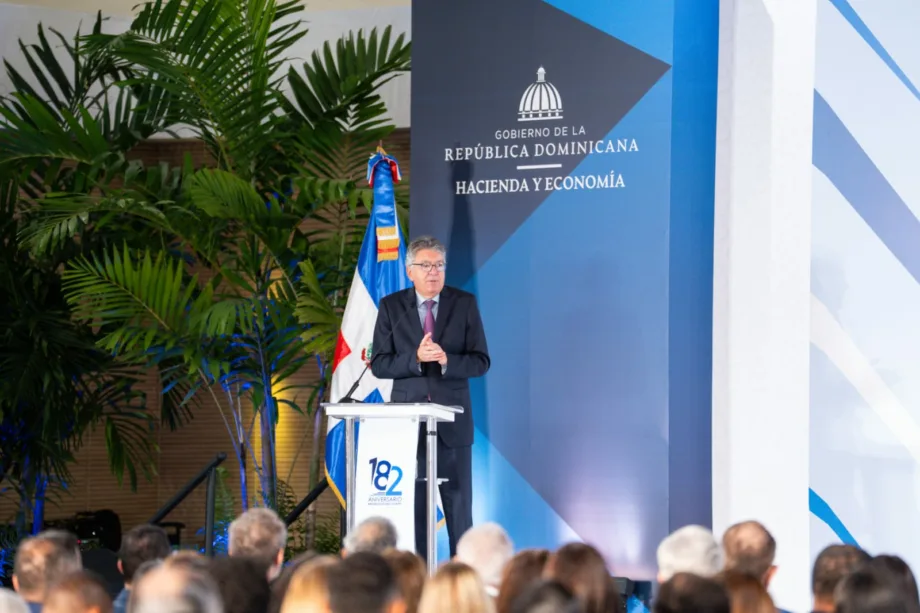
The Dominican Republic is coming to the current international crisis from a position of strength, allowing it to have a better management space to keep its economy stable despite the persistent external shocks, said Mauricio Cárdenas, former Minister of Finance and Public Credit of Colombia, at the beginning of the activities for the 182nd anniversary of the Ministry of Finance and Economy (MHE).
Cárdenas, who is an economist of Columbia University, delivered the conference “Management of the fiscal situation in times of uncertainty,” which was led by Minister Magín Díaz.
In that scenario, he stressed that the country shows resilience with real GDP growth above its region peers, a country risk indicator (EMBI) contained, and a public debt that, following post-pandemic fiscal efforts, has maintained its downward trend.
In addition, the Dominican Republic is one of the Latin American economies that most attracts foreign direct investment with 3.9% of GDP.
Within the key sectors of best performance he cited construction, manufacturing and tourism which show signs of recovery, with a rebound in the arrivals of non-resident passengers and dynamism in the building licences. Followed by an optimistic business climate.
2026 breaks the decline in public investment
During his exposure, Cárdenas specified that, in each crisis, the exhaust valve was public investment. And 2026 is breaking that pattern in the country.
The central government's public investment fell from 4.5% of GDP in 2000- 2009 to 2.5% in the period 2010- 2022, while current expenditure was growing.
However, he noted that between January and September 2026, capital spending increased by 13% despite the oil shock. The challenge, he said, is that that protection on the rise is a rule and not an exception.
“Stopping investment relieves accounts today, but costs productivity and growth tomorrow,” Cárdenas said.
World convulsion
In the light of these details, the economist warned that the world no longer has trade or growth as its priority, but rather the geo-economy that maintains global uncertainty at historical levels.
He observed oil as one of the main shocks, indicating that the war in the Middle East slowed down deinflation in Latin America and increased crude oil. In the middle of this, he warned that for the Dominican Republic the local price of hydrocarbons is not determined by the barrel, but by its derivatives, whose costs have remained considerably high.
The result of this was that the fuel subsidy in the country already exceeds 0.4 per cent of GDP, which is more than three times the expected.
In this regard, it recognized the Government's response combining subsidies, reallocation of expenditure and additional income with Law 30-26.
Proposals
After detailing this picture, the well-known economist suggested measures that the Dominican Republic can take in the midst of this picture, among which he cited, a more robust fiscal framework; better spending; layer financial protection in the face of eventualities; protecting capital spending and the formation of an independent tax council.
These measures would seek to ensure the sustainability of finance and to continue the country & apos; s development and growth path.
About the event
The event, held in the Ministry of Foreign Affairs (Mirex) with the support of the Inter-American Development Bank (IDB) and the World Bank, also included the expert panel “Economic Perspectives for Latin America and the Caribbean,” moderated by Magín Díaz, Minister of Finance and Economics, with the participation of Tomás Bermudez, manager of the Regional Department of Central American, Haiti, Mexico, Panama and the Dominican Republic (CID) of the IDB; Juan Pablo Uribe, director of the Division for Mexico, Central America and the Dominican Republic of the World Bank; and Alberto Barreix, former chief fiscal leader of the Inter-American Development Bank (IDB).