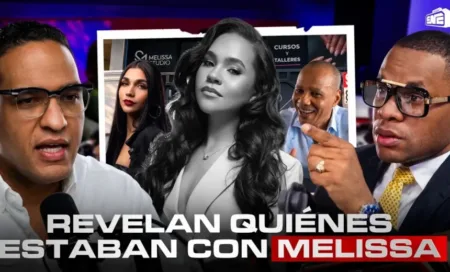





New revelations about the circumstances surrounding the death of the young entrepreneur and influence Melissa Medina have come to light following the testimony of Venezuelan Mariana Pascual, who was accompanying her during the hours she presented the medical emergency that ended her life.
During a conversation with the communicator Ramón Tolentino, Pascual provided details about what happened that morning and said that Melissa's sentimental couple did not know that the young woman had left her residence to meet with businessman Eliezer Salvador.
According to his version, Melissa had told her boyfriend that she was sleeping, so he understood that she remained in her home and had no knowledge of the movements she would have subsequently made. «Melissa had told the boyfriend she was asleep,» Mariana said, who said that the young man was surprised to learn about what happened and to learn that her partner had left early in the morning.
This element introduces a new dimension in the questions surrounding the case, as it raises differences between what Melissa's sentimental partner allegedly knew and what would have happened during the hours before her death.

The Venezuelan woman also rebuilt part of what happened when Melissa presented health complications. He said he remained at his side during the transfer to the United Hearts clinic and did not leave her at any time, while hoping that she could receive medical assistance and recover.
According to his account, after arriving at the medical centre and knowing the seriousness of the situation, he decided to communicate with Eliezer Salvador to inform him about what had happened and to let him know that the authorities were also involved. Mariana stated that the entrepreneur reacted unbelievably to the news. Among the expressions he attributed to him is the figure: 'This can't be happening, we've never been through anything like this.'.
Pascual added that he continued to communicate with Salvador to keep him informed of the proceedings and that he was subsequently assisted by a lawyer sent by the employer, whose last name he tentatively identified as Bonilla.
As for the efforts to locate Melissa's family, he explained that he had to resort to a person known to his environment to get contact with the mother of the young woman. Subsequently, several relatives and relatives began to arrive at the health establishment, including their parents and their sentimental partner. Mariana Pascual's testimony places on the table a particularly delicate aspect of this case: the personal circumstances surrounding Melissa Medina's departure during that early morning and her sentimental partner's apparent lack of knowledge of that encounter.

Beyond personal relationships, the differences between what each involved knew and what later came to light make it necessary to rebuild events with precision. What happened before Melissa presented the medical emergency? Who knew their movements? What information can each person who was with her during those hours provide?
It is also important to distinguish between the statements offered by Mariana and the facts that can be corroborated by independent testimonies, communications, records and evidence collected by the authorities.
The death of a young woman of just 22 years should not become a show of statements and versions faced on social media. It is an event that deserves serious, transparent and respectful research with all the people involved.
The call is for those who have relevant information to work with the authorities and for society to avoid early sentencing of any person without evidence-based conclusions. Melissa's family deserves to know what really happened during its last hours and that, if appropriate, responsibilities are established in accordance with the law.

Watch video: