






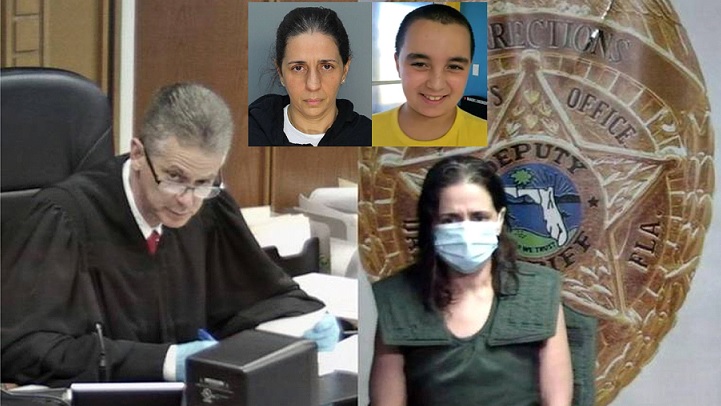
Dominican Patricia Ripley, who admitted that she drowned her 9-year-old autistic son on a Miami channel, faces the death penalty, according to the Florida law on capital crimes.
Ripley, 45-year-old, resident of the West Kendall suburb and who also invented that the child had been kidnapped by two African Americans who intercepted her on a road, demanding drugs from her where they took her son and then killed him, tried a first time to drown the child in another lake, but there was rescued by three witnesses, said Miami Dade's prosecutor, Katherine Fernández Rundle, during a bail hearing on Saturday before Judge Oscar Rodríguez Fonts, who denied the petition.
Although the lawyer for the Dominican murder, Nelson Rodríguez Varela, claimed that she is an excellent mother and that the weight of taking care of the autistic child who did not speak, he overwhelmed her, leading her to commit the crime, the Florida law on capital punishment, does not see this as a mitigating but aggravating circumstance.
The law imposes the maximum sentence when the evidence shows that the crimes are committed by a person previously convicted of a serious crime, sentenced to imprisonment, placed in community control or on parole for serious crimes.
Also when they have been previously convicted of other capital crimes or of an offence involving the use or threat of violence against the person, the accused knowingly created a great risk of death for many people.
The law applies when the crime was committed while the accused was involved, or was complicit, in the commission or in an attempt to commit a specific offence such as aggravated child abuse, arson, kidnapping, placing or unloading a destructive device or bomb, was committed for the purpose of preventing or preventing a legal arrest or a escape from custody, was committed for financial benefit, committed to interrupt or hinder the legal exercise of any government function or the application of the laws.
The crime was particularly heinous, heinous or cruel, committed in a cold, calculated and premeditated manner without any pretext of moral or legal justification, the victim was a law enforcement officer involved in the performance of his official duties or an elected or designated public official who performed his official functions if the motive for the capital crime was in whole or in part related to the official capacity of the victim.
Also if the victim was a person under 12 years of age, particularly vulnerable because of the elderly or disability, or because the accused was in a position of family authority or custody over the victim.
It was committed by a criminal member of a gang or by a person currently or previously designated as a sexual predator, by a person subject to a restrictive order or a foreign protection order, and was committed against the person who obtained the mandate or protection order or any spouse, son, brother or father of that person.
The Florida Statute also provides for the death penalty for the capital drug trafficking.
As established by law in Florida, Mrs. Ripley is applied several categories that justify her execution in the electric chair, gas chamber or lethal injection, according to the method chosen by the judicial authorities.
At best, and if it is shown that she was suffering mental disturbance at the time of killing her child, she would be sentenced to life imprisonment for first degree (voluntary) murder and other related crimes, but the judge is likely to rule out that argument, on the basis that she admitted the murder in full control of her mental capacity.
Since 1976, 99 convicted killers have been executed in Florida, all in that state prison.
Since 4 February 2020, 340 offenders have been awaiting execution.
The prosecutor said that Ripley, is charged with premeditated murder and was held in prison without bail, although she did not refer to a possible request by the prosecution for the death penalty.
El cuerpo del niño fue encontrado flotando en un canal el viernes.
El padre de la víctima, Aldo Ripley, quien estuvo en la audiencia el sábado dijo entre sollozos que no podía hablar mal de su esposa y que no tenía palabras para referirse al asesinato de su hijo en un momento tan devastador.
El abogado defensor, describió a la familia como un ejemplo de bienestar y buena conducta y explicó que no hay antecedentes sobre problemas entre los esposos ni que involucren al niño.
"Desafortunadamente cuando ella lo llevó al segundo canal no había nadie allí", agregó la fiscal. “Ella lo intentó una vez y la gente lo rescató. El estaba vivo. Pudo haberse quedado con vida. Tenía la intención, según todos los hechos del caso, de matarlo”.
Adelantó que se realizaría una autopsia al niño el sábado para determinar si tenía otras lesiones o alguna sustancia tóxica en su sistema. La fiscal dijo que aún no se ha tomado una decisión sobre si los fiscales buscarán la pena de muerte.
Señaló que como el niño no hablaba, no podía haber contado a sus rescatistas iniciales lo que había sucedido con su madre en el primer intento de ahogarlo.
“No puede decir nada a sus rescatadores. Hablamos de niños sin voz. Este es otro nivel de falta de voz. Era incapaz de decir que mami me metió en el agua", explicó la fiscal. Video del suceso:
“Amamos a Alejandro, y nos molestó lo que dijeron sobre mi esposa. No es real", expuso al padre restando crédito a la publicación de los medios sobre el caso.
El abogado dijo que integrará un equipo defensor para que ella tenga la oportunidad de reivindicar su buen nombre y le pidió al público que se reservara las opiniones para cuando salga más información.
"Obviamente hay un gran apoyo para ella", dijo. "En todos los sentidos, ella ha sido una madre excelente, una persona excelente, una gran familia como se puede ver en las personas que están aquí".
La policía de Miami Dade dice que la madre afirmó originalmente que fue emboscada por dos hombres negros que le exigieron drogas y tomaron su teléfono celular, tableta y al niño, antes de huir el jueves por la noche, lo que provocó una Alerta Amber en el área al sur de Miami.
El cuerpo del niño fue sacado del canal de un campo de golf la madrugada del viernes mientras la policía continuaba interrogando a la mujer.
Una declaración jurada de arresto dice que ella proporcionó declaraciones contradictorias, y finalmente se enfrentó a testimonios de testigos y videos que muestran el primer intento de empujar al niño al canal.
El documento dice que ella se retractó de su historia y admitió que condujo a otro sitio y llevó al niño a un canal diferente diciendo que "él va a estar en un lugar mejor".
For: Miguel Cruz Tejada