





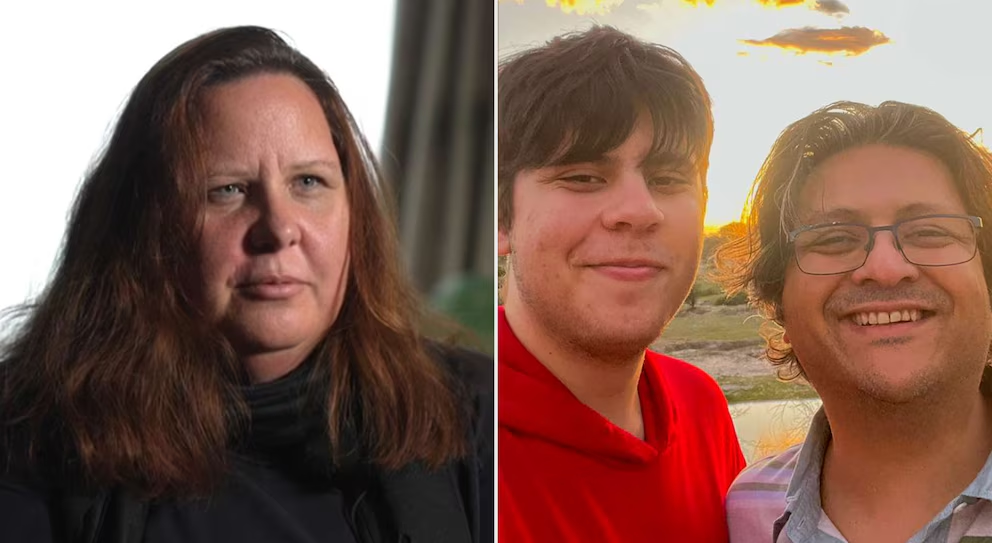
Two boxes the size of a shoe. That's what Christine Dawood received nine months after the submersible Titan imploded at 3,800 meters deep in the North Atlantic.
Inside, the remains of her husband Shahzada and his 19-year-old son Suleman: biological material separated with DNA tests by the DNA Identification Laboratory of the U.S. Department of Defense (AFMES-AFDIL), based in Dover, Delaware.
“When I say bodies, I mean the liquid left,” Dawood said in an interview with the British daily The Guardian.
“They came in two small boxes, like shoe boxes.”.
The image is disturbing, but it accurately reflects the nature of what happened on June 18, 2023, when the Titan, operated by the company OceanGate, suffered a catastrophic implosion during its descent into the remains of the Titanic RMS.
At 3,346 meters deep, the ocean pressure - about 380 times the atmospheric at sea level, equivalent to the weight of about 50 elephants being concentrated on an area of the size of an A4 leaf - collapsed the submersible helmet in a fraction of a second.
We recommend reading: El Salvador: Mother and stepfather convicted of murder of a under-two year old
The five occupants died instantly: the executive director of OceanGate, Stockton Rush, the Pakistani-British businessman Shahzada Dawood, his son Suleman, the British businessman Hamish Harding and the French explorer Paul- Henri Nargeolet, the world's largest authority over the Titanic, who had already visited the country 37 times.
The forensic process that gave back something to the families
According to United States Coast Guard (USCG) documents, the first human remains were recovered from the ocean bottom on June 28, 2023, when the Horizon Arctic ship arrived in St. John's. John's, Newfoundland, with the first fragments of the submersible.
In October of that year, a second rescue operation recovered additional remains, this time from the inside of the Titan's debris, and transported them to an American port for analysis. “The remains were carefully recovered and transported for analysis by medical professionals from the United States,” USCG said in a statement. Image of the seabed shows fragments of the Titan submersible after implosion during a dive to the Titanic
The identification work was on the AFMES-AFDIL, the same laboratory that identifies the remains of military personnel who were fallen in combat. The DNA profiles of the five deceased were confirmed positively, as recorded in the presentation of the USCG Marine Research Board (MBI), published in September 2024.
The process took months because implosion left almost nothing recognizable. The physics of the event explains this: when the Titan's helmet gave in, the compression of the inner air was so violent that, according to simulations developed in 2023, the temperature within the submersible reached briefly values comparable to the surface of the sun, all in less than two milliseconds.
What was left at the bottom of the ocean were fragments of the rear cone, the back dome, titanium rings and carbon fibre remains, scattered within a radius of about 500 meters north-east of the Titanic bow.
Dawood received only what the lab could certainly attribute to Shahzada and Suleman. There was also a pile of biological material with mixed DNA that could not be assigned to any particular victim.
“They have a lot they can't separate, all DNA mixed, and they asked me if I wanted part of it too. But I said no, only what they know is Suleman and Shahzada,” Dawood told the British newspaper.
A helmet that should never have been submerged to that depth
The final report of the MBI, a 335-page document published in August 2025, concluded that the tragedy could have been avoided.
The main cause was the poor engineering process of OceanGate for Titan, which resulted in the construction of a carbon fibre hull composed of multiple anomalies that did not meet the requirements of resistance and durability necessary to operate at that depth.
The choice of the material was, from the beginning, a high-risk bet. Conventional deep-water submersible use high-strength titanium or steel spherical helmets, materials that evenly distribute pressure in all directions. Carbon fiber, on the other hand, is an extraordinarily resistant material under voltage, but weak under compression.
Each immersion would submete the Titan cylindrical hull to what engineers call “cyclical load”: the pressure increased by 38.000% during the descent and returned to zero when ascending. This repeated cycle generated microfractures and progressive delaminations in the hull layers.
The National Transport Security Council (NTSB) investigation found that the Titan's helmet was damaged irreparable in July 2022, during the 80-day dive, when passengers heard a strong explosion on the rise.
The deformation sensors recorded a permanent change in the structural response of the hull. Rush ruled out the incident as a displacement from the frame and did not order any investigation. Each of the four subsequent dives was, as the BBC described, “a disaster waiting to happen.” The Horizon Arctic ship in the port of St. John's, Canada, after the return with recovered fragments of the Titan submersible.
The hull spent the six months before the fatal trip parked on the open in a parking lot in St. John's. John's, exposed to the winter of Newfoundland, conditions that engineers consider inadequate for a carbon fibre material.
The Titan's last message reached the surface on June 18, 2023 at 10: 47: 09 a.m., when the submersible was at 3,341 meters deep: “Dropped two wts” (“Let's drop two pesos”), a routine procedure to adjust the float. Seven seconds later, the helmet failed.
The mother who gave in her seat
Christine Dawood wasn't at the Titan. He had given his place to Suleman so that the teenager could accompany his father. Shahzada, a member of one of Pakistan's most wealthy families, had insisted on going directly to the Titanic without previous training dives. “If I'm going to do a dive, I want to do it right,” he told his wife. The price of the two seats: $500,000. Shahzada Dawood and his son Suleman, two of the Titan's victims; his family recalled the enthusiasm of the entrepreneur before the trip
Dawood, a training psychologist, was on board the Polar Prince, the surface ship of OceanGate, when at 11 a.m. on 18 June he heard that they had lost communication with the submersible.
You can also read: “Vecina says mother of a girl found lifeless in Los Girasolas is” working and dedicated to her children "
At 18: 30, the mission director of OceanGate officially declared the Titan missing. Four days later, a remote operation vehicle deployed from the Horizon Arctic reached the bottom of the ocean and found the remains of the submersible rear cone. The implosion had occurred almost since the beginning of the descent.
“My first thought was: thank God,” Dawood admitted. “When they said catastrophic, I knew that Shahzada and Suleman didn't know anything. One moment they were there and the next no longer.”.
A Canadian Coast Guard officer present when Dawood landed gave him the advice that most remembers: ”Spin things around won't help you, so don't fall into that trap. The fact that you know now... means you didn't know before.”.
Legal and regulatory consequences
The MBI report noted that, had it survived, Rush had faced charges of culptuous murder before the United States Department of Justice. The document also identified a toxic organizational culture in OceanGate: employees who raised alerts about Titan security were threatened with demands or fired. Shahzada Dawood, Vice President of Engro Corporation, with his son Suleman in an undated image of the Titan trip.
David Lochridge, former director of the company's marine operations, testified to the MBI that he was fired in 2018 after presenting a report that warned about the failures of the carbon fibre hull.
“I knew that helmet was going to fail,” Lochridge said during the September 2024 hearings in North Charleston, South Carolina. The OSHA Labour Regulatory Agency received Lochridge's complaint but did not follow up, an omission that the final report described as a missed opportunity to prevent the tragedy.
The MBI issued 17 safety recommendations, including the creation of an international regulatory framework for passenger submersibles and the obligation for operators to submit emergency plans to the maritime authorities before each immersion.
In the house of Surrey where he lives with his daughter, Suleman's room remains intact. In the center of the kitchen, within a glass window, the Lego del Titanic model that Suleman built with 9,090 pieces remains in place.
“What was I gonna do? Destroy it, hide it? Suleman spent all those hours,” Dawood said.