Yeni Berenice Reynoso reiterates his call to join in the will to establish a culture of peace that will promote the coexistence and well-being of the entire population
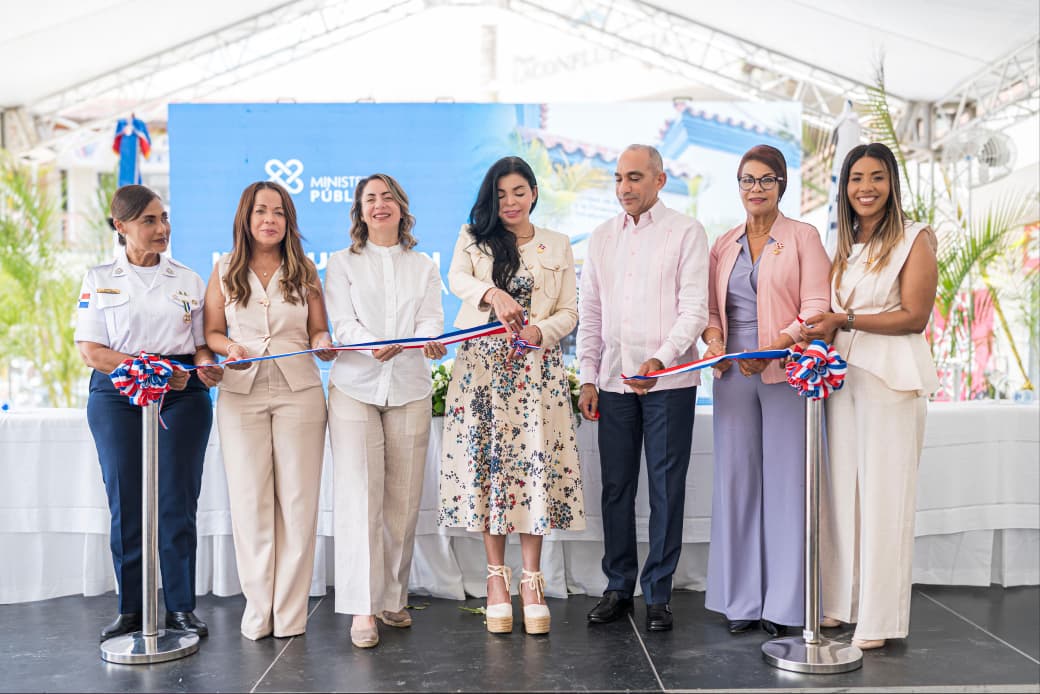
- As part of her efforts to bring the Public Prosecutor's Office closer to the communities and to ensure comprehensive care for the victims, Attorney General Yeni Berenice Reynoso delivered a new Unit for the Comprehensive Care of Victims of Gender-based Violence, Domestic Violence and Sexual Offences on Saturday, as well as the offices of the Legal Service for Victim Representation (Relevic) and the Tracing Court Prosecutor.
Reynoso, who on the eve left the Gender Violence Unit and the Relevic office in Hato Mayor, highlighted the benefits of bringing services to communities.
He recalled that the Public Prosecutor's Office opened 37 Relevic offices at the national level, with 142 lawyers to assist victims who have no resources free of charge.
He held that he was sad to share statistics on gender-based violence. “But I share them because society must know that the Public Prosecutor's Office received, for example, last year, more than 700,000 cases of gender, domestic and sexual violence,” he said. The event was attended by Gloria Reyes, Minister of Women, and Vice Admiral José Manuel Cabrera Ulloa, President of the National Drug Control Directorate (DNCD).
Members of the High Council of the Public Prosecutor & apos; s Office participated, as did the Deputy Prosecutor Wilson Camacho, head of the General Directorate of Prosecution of the Public Prosecutor & apos; s Office; Ana Andrea Villa Camacho, head of the National Directorate against Gender Violence of the Public Prosecutor & apos; s Office; and María Rosalba Díaz, head of the National Service for Legal Representation of the Rights of the Victim (Relevic).
The activity was attended by the general prosecutor Yanet Jiménez, the head of the Special Directorate for the Care of Women and Domestic Violence of the National Police (Deamvi); the court prosecutor Yessica Ramírez, head of the Regional Attorney-General's Office of La Vega, and Viviana Mena, the head of the prosecutor of Jarabacoa.
In addition, Arelis Ricourt, representing the judiciary, Colonel Ramón Dicló Mateo, regional director of the National Police in La Vega, and Elizabeth Rodríguez, coordinator of the Public Defence in the province.
You may be interested: DNCD and Public Prosecutor's Office occupy more than 13,000 grams of drugs in operations on Gran Santo Domingo
The priest Alberto Espinal, from the parish Our Lady of Carmen, who was in charge of the blessing of the act, highlighted the value of the implementation of the new organ.
“We call for the multidisciplinary team to be established here to design programmes to accompany the affected individuals and families, raising awareness, healing wounds and cutting the cycle of violence at the root,” said the religious.
Meanwhile, the prosecutor Mena Paulino stressed that with the new services the quality of care for the citizens is improved. “This unity is born because we understand that behind each case there is one person; there is one person who deserves to be heard, who deserves attention in a dignified and comprehensive way, without prejudice or revictimization,” he said.
Contact with the living sectors of society
“I tell the whole team that today will be working from this unit: do not focus on persecution alone, communicate with the community, join them to the church, clubs, representative sectors of society, it is not them and we, we are all united by the construction of a better country,” said the Attorney General of the Republic, in pronouncing the central words of the act.
Yeni Berenice Reynoso reiterated the courage of strengthening the family and school to achieve a better society.
He agreed with the priest Alberto Espinal on the need to strengthen the family to change society. He also advocated working in schools with the formation of a new model of citizen. “If that school and the center of society that is the family is full of violence, we will have violence in all areas of society,” he said.
“The son who sees the father beating his mother understands that the language of resolving the difference is the blows, because he thinks his subconscious if my mother deserves blows, everyone else also deserves blows,” he said.
Reynoso indicated that statistics provide that in a home where a child or adolescent sees violence, the possibility of replying it is more than 85 % within the family framework, within the social space in which it develops.
“We have to join as a society and stop that wave of violence that mistreates women, children, adolescents, who kill by a parking lot, by a piece of bread, by a vehicle rote, who kills by an ideological difference, that kills by a difference between neighbors, that kills a father, that kills a mother, that kills a wife, that kills a son or daughter,” he said.
He noted that out of every 10 homicides in the Dominican Republic, at least 6 are the products of violence that came up in a difference that would be resolved by a simple conversation.
“That society, then, which uses violence as a means of conflict resolution, is the one we want to prevent,” he said. “It is a mistake to think of violence to reach the homes of others, it will not reach mine; I am not exempt from violence, that is something that we must all think of, because in one way or another, to a greater or lesser extent as a social entity we participate in different spaces that are social,” he said.
He argued that in his management he drives a philosophy of service to develop a “People-centred Public Prosecutor's Office,” a vision that drives with the commitment to serve and to carry out a profound process of change, transformation and institutional innovation.
During the first quarter of 2026, the Public Prosecutor's Office of the Dominican Republic has registered a total of 17,525 complaints at the national level, showing the extent of cases of gender-based, domestic and sexual violence.
In the municipality of Jarabacoa, 81 complaints have been reported, broken down as follows: 18 cases of gender-based violence; 42 cases of domestic violence, consisting of physical, verbal and psychological and property violence; 21 cases of sexual offences, of which 7 are sexual assault, 2 sexual rape, 2 sexual harassment, 5 child abduction and 5 child seduction.