Bogotá.- The wave of violence in the south-west of Colombia, which leaves at least 19 civilians dead after a guerrilla attack with a bomb cylinder on the Pan American Way, moved to the campaign for the presidential elections on May 31, with a cross-section of accusations among the main candidates.
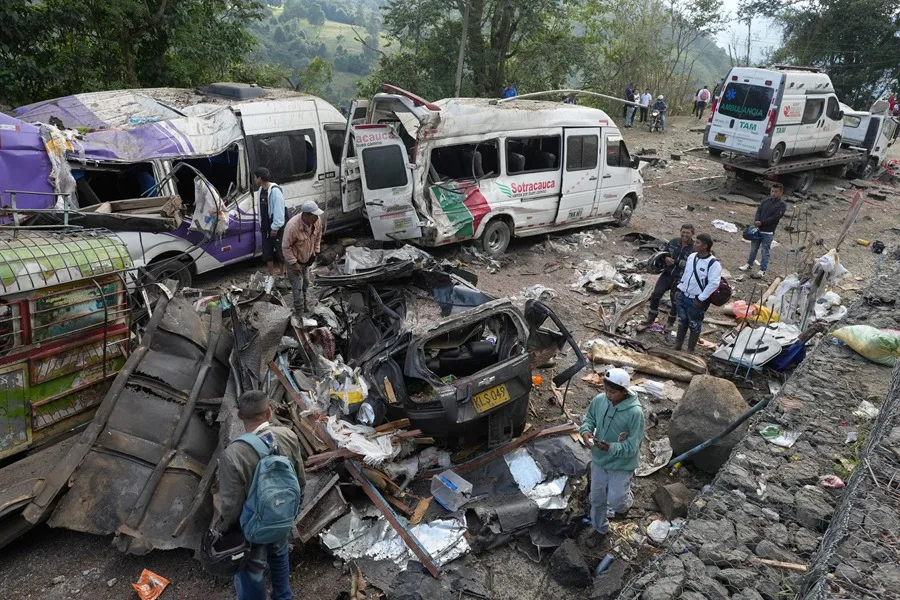
The attack on Saturday in the El Tunel sector, in the municipality of Cajibío, department of Cauca, and attributed by the authorities to dissidences of the former FARC, has encouraged political debate on the armed conflict and peace only 36 days from the presidential elections.
The candidate for the official Historical Pact, Ivan Cepeda, condemned the attack and expressed his «strongest rejection» of what he described as acts of barbarism against the civilian population, but also raised the question of «legitimate concern» about whether these events seek to generate a climate of fear that will favour far-right sectors in the midst of the electoral process.
«It is deeply worrying that these terrorist actions are being presented in regions in the south of the country where there is broad citizen support for our political project,» Cepeda said on social networks.
Critics to «total peace»
From the opposite shore, the candidate for the right-wing opposition party, Paloma Valencia, rejected Cepeda's interpretation and accused him of diverting attention, while holding that President Gustavo Petro's «total peace» policy has failed and is responsible for the deterioration of public order.
One person observed, on April 26, 2026, the place where an attack took place at the Via Panamericana in Cajirio, Colombia. EEF / Ernesto Guzmán
«The country does not deserve to be diverted by insinuating that this is intended to favour political sectors. The time came to assume, with all the letters, that total peace failed,» Valencia responded to Cepeda in X.
Petro's «total peace» policy includes dialogues with the National Liberation Army (ELN) guerrillas who failed to reach a good port and also negotiations with FARC dissidences and the submission to justice of gangs such as the Gulf Clan, the country's largest criminal organization, with no tangible results so far.
We recommend reading: 19 civilians killed by the attack on the Pan American Way in Colombia are being promoted
In the same vein, the ultra-right-wing lawyer Abelardo de la Espriella, from the Firmes movement for the Homeland, said that recent violence is a direct consequence of that strategy and proposed a «front war, without truce or negotiation» against illegal armed groups.
«These are not isolated acts. They are part of a plan to destabilize Petro's disgovernment and his accomplices,» the candidate said in a statement published by his campaign.
A «weakened» State in the face of violence in Colombia
Sergio Fajardo, of the Dignity and Commitment Center party, expressed his solidarity with the victims and said that «Colombia is bleeding again,» while at the same time considering that the Government's security policy has weakened the authority of the State and requires urgent review.
The criticism also was also joined by former President Ivan Duque (2018- 2022) who said that recent events reflect «the consequences of a policy of appeasement» which, in his view, has weakened security and reduced the offensive capacity of the State, while expressing its support for the security forces.
The attack in Cajirio took place in the middle of a wave of violent actions in the south-east of the country, where in recent days, there were also bomb-cylinder attacks on military units in Cali and Palmira, in the department of Valle del Cauca, which left no casualties
On Saturday, a Civil Aeronautics radar was also attacked in Cerro Santana, in the municipality of El Tambo (Cauca), all of these events attributed by the Army to the various groups that make up the Central General Staff (EMC), the main dissidence of the FARC, led by Néstor Gregorio Vera, alias Ivan Mordisco, the most wanted man in Colombia.