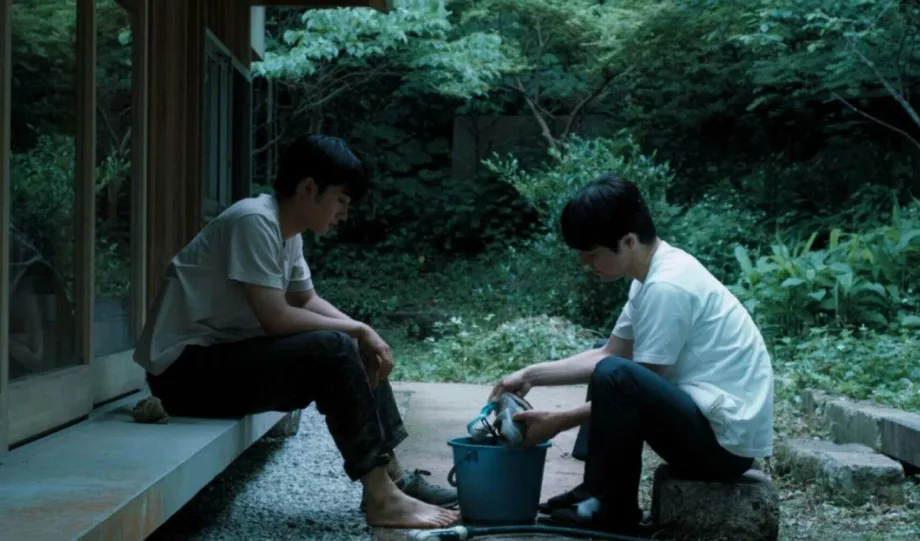
There are films that find their rhythm in the daily, and the first feature film by young Japanese director Yaza Takenoshin, who graduated from Harvard last summer, does so almost with millimetric precision. From numbers repeated on an exam to the purchase a mother pays in the supermarket box, everything goes with a measured and pleasant cadence.
The film, Hinotama (title still without a confirmed premiere in Spain), is part of the Nippon Cinema Now section of the Tokyo Film Festival, a space dedicated to emerging Japanese filmmakers. The story follows the young Takeshi (Riku Onishi) while watching the breakdown of his parents' marriage, a slow but inevitable process marked by subtle and obvious signs at the same time.
More and more disheartened by the defects of his parents, Takeshi is obsessed with the fireball his old friend Akari (Himena Irei) speaks of. Maybe he's hoping that seeing her will give him back that child-like stamina capacity he seems to have lost.
Ryusuke Hamaguchi's print on each frame
Yaza does not hide his admiration for Ryusuke Hamaguchi, winner of the Oscar with Drive My Car, and that influence is seen in a careful and constant photograph, never cold, and in the patience with which he looks at his characters. The connection is direct: the film was shot by Yoshio Kitagawa, the director of occasional photography of Hamaguchi, who offered to film it when the student asked for advice.
Kitagawa is committed to symmetry, highlights the geometric lines of the family house and places objects or people in the center of the plane. These orderly compositions end up looking like a cage, something that already suggests Mari Kusu's interpretation as Takeshi's mother, overflowing by frustration.
Soon, short dialogues break that pulcrituality. The father drops his discontent into an isolated comment that ends in a major discussion, in which he demands respect and complains that his children never thank him. Takeshi roams all over it without showing his discomfort, until it breaks out: he destroys impeccable slippers by jumping into a mud pool, an even more shocking moment by the quietness of the camera.
A family portrait contained with some stumbling
The father is a petty and proud man, although Yaza reveals his nuances little by little. It is not just a collider type: it starts a campaign to prepare their children for separation using very significant memories for them. The director seeks contained interpretations, especially in Onishi, which gives life to an increasingly isolated and tormented young man.
That sober tone sometimes turns out to be somewhat burdensome and forced, as in the children's scene in line while the younger brother, Kento (Koe Odani), is walking towards his new home. A sudden three-month leap destabilizes the story, although it leaves moving moments, especially when Kento is suddenly mature and trying to relieve the pain of his family.
The outcome is entered into an allegorical record that does not fit fully with the best of the film, its gradual portrait of the cracks in a traditional family. Still, Hinotama is a very promising prime opera.