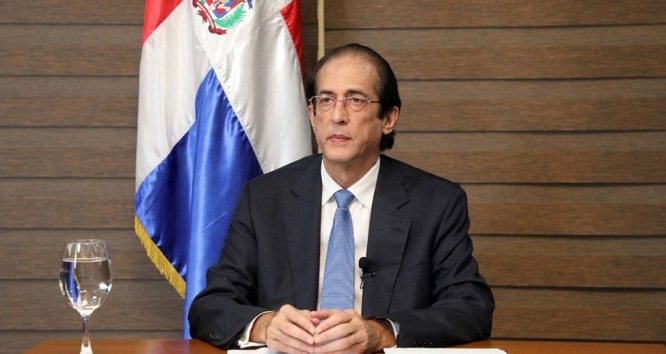
President Gustavo Montalvo said on Friday that in the face of the crisis caused by the COVID19 pandemic, it is necessary to create a tax pact that will promote economic recovery and increase public income and guarantee social protection policies.
“Now more than ever, we have a responsibility to protect the most vulnerable families while they are reentering the labour market, to undertake the structural reforms that will drive our economic development and the protection of the work of citizens and their new forms,” the minister said.
“We have an obligation to transform these challenges into opportunities that will help to generate the changes that our societies need to move forward,” the minister said.
In the face of this, Montalvo stressed the need to improve the welfare state, to speed up the formalization of businesses and, above all, to protect employment.
To this end, Montalvo added, social cohesion, based on citizens' rights and duties, and on the consensus of society around common commitments and goals, must be strengthened.
“Only through dialogue and consensus will we achieve at this time of difficulty to consolidate our democracies and achieve results based on the true needs of people,” Montalvo said during his participation in the Virtual Ministerial Summit on Social Inclusion for Latin America and the Caribbean “Information and social inclusion in the time of COVID-19,” which is chaired by the Dominican Republic.
The event is organized by the Organization for Economic Cooperation and Development (OECD) for Latin America and the Caribbean.
During the session, inclusive social dialogue and citizen participation to improve social cohesion and identification with recovery measures, Minister Montalvo highlighted the social and economic impact of the pandemic, as well as the need to make “unstoppable” decisions for the country as a whole.
The Ministerial Summit brings together ministers and high-level officials from labour, planning, economic and social development institutions. The objective of the meeting is to hold a debate on the difficulties that the COVID19 crisis poses for the advancement of social inclusion.
Also, identify initiatives and opportunities that will enable countries to create jobs and move to work formality, and encourage the search for consensus on the socio-economic reforms that will be implemented following the COVID19 crisis.