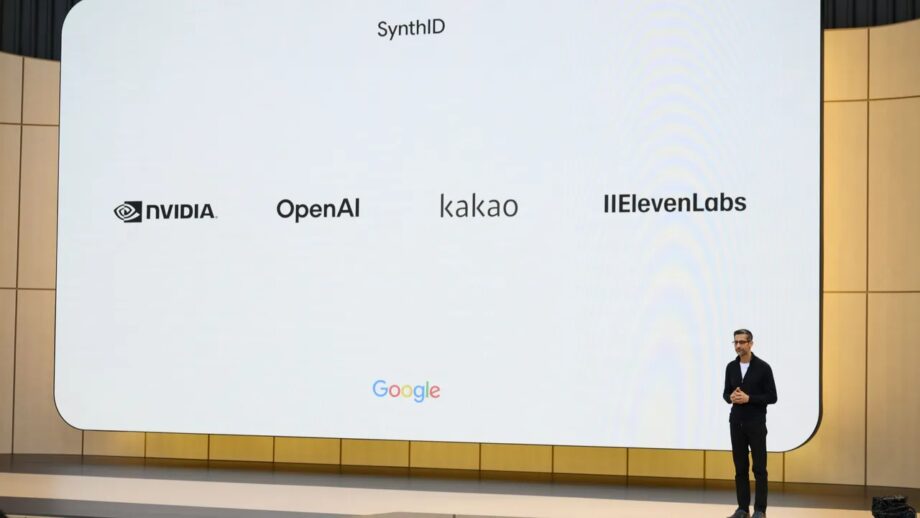
It will now be easier for everyone to discover whether a multimedia content was created or edited with artificial intelligence (IA). At least, this is Google's promise after the release of SynthID Detector, a new open website that allows anyone from anywhere to detect whether an image, audio or video was generated or manipulated by some algorithm.
In 2023, the company presented SynthID, a mechanism that, by means of watermarks imperceptible to the human eye, label audios, images and clips generated with IA. According to Pushmeet Kohli, Vice President of Science and Strategic Initiatives of Google DeepMind, so far, more than 180 billion images and videos, as well as the equivalent of 240,000 years of audio content, have been marked with this system.
Despite the magnitude of the figures, those interested in detecting materials created or modified in a synthetic manner needed specialized software, capable of identifying and reading the SynthID marking.
To address the problem, last year Google presented the preliminary version of SynthID Detector. However, their access was restricted to certain media. This just changed.
Why Claude's invisible labelling system is so easy to avoid
Anthropic will incorporate an invisible mark in the texts processed by Claude to identify the use of IA, although the labelling can be lost after editions, paraphrase or translations.
Google announced that from today on, anyone can use the detection tool. The opening, according to Kohli, responds to the company's commitment to provide more information and mechanisms that enable audiences to develop a better criterion about what they use on the Internet.
“As IA tools improve and become easier to use, having a clear context about the content you find online helps you make informed decisions about what to trust. With the new SynthID Detector, anyone can easily check whether an image, video or audio file has been created with artificial intelligence,” he said.
How does the IA detector launched by Google work?
The tool is available on a dedicated website. Users should log in with their Google, ChatGPT or Apple credentials. After accepting the terms and conditions of use, as well as the access permits, simply enter the content you want to analyze to get the system to start working quickly and easily automatically and, in a few seconds, deliver a result directly.
The Google team points out that, in case the tool identifies a watermark, it is “likely that [the material] was edited or generated by a SynthID-compatible IA model.”.