






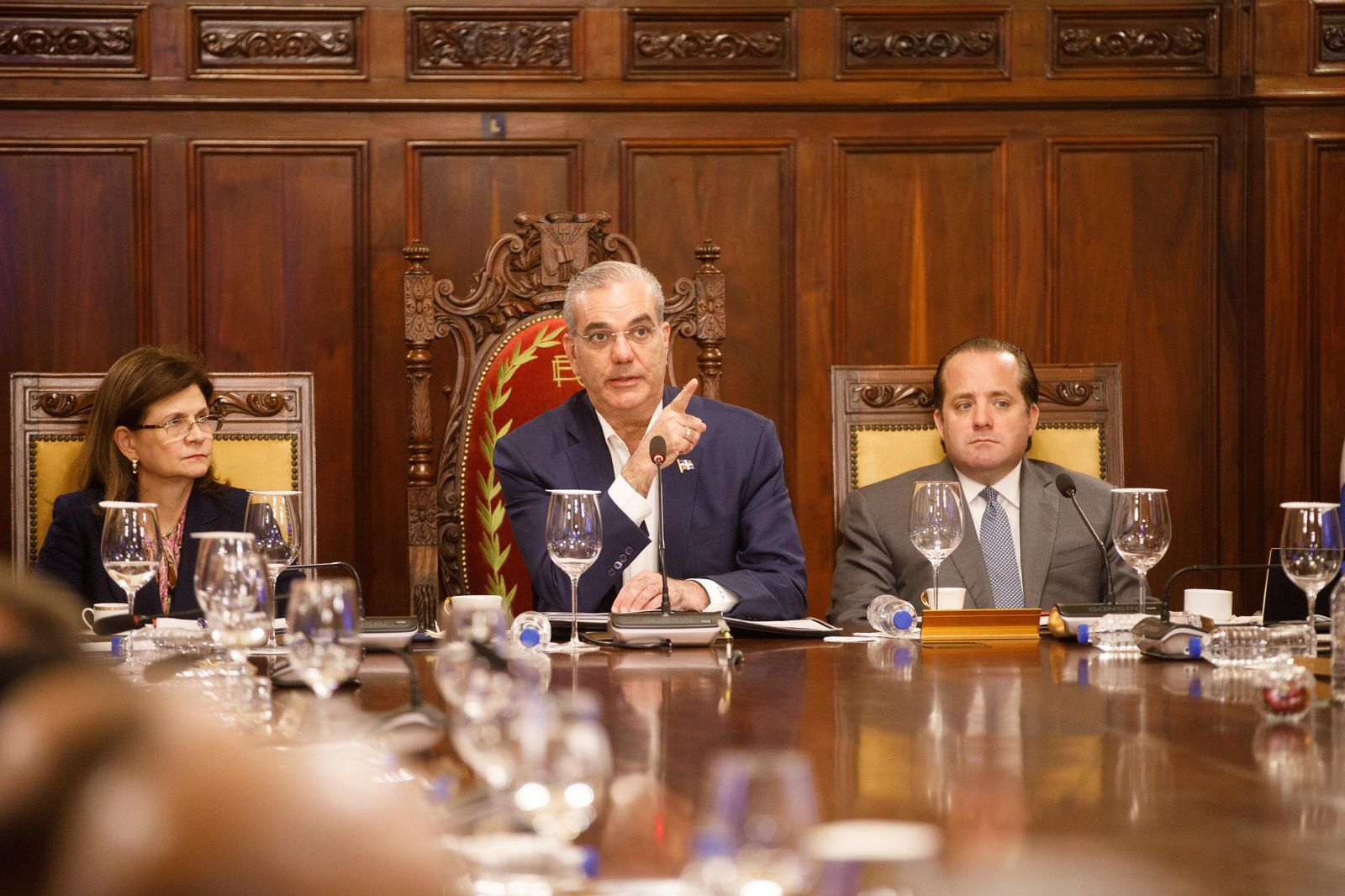
President Luis Abinader and Vice President Raquel Peña led the fifty-seventh Council of Ministers, held at the National Palace, to follow up the government plan to address the impact on the Dominican economy of the crisis in the Middle East.
José Rijo Presbot, Director-General of Budget, explained that the Government has provided a number of measures to contain and efficiently manage public expenditure to generate availability close to RD$400 billion, based on the principle of respecting all commitments already entered into under contract, while those budget appropriations not yet committed will be subject to review, adjustment or reduction according to national priorities.
He noted that these actions include the reduction of operational costs, the containment of vehicle acquisition, with the exception of priority areas such as social assistance and food security, the reduction of repairs and minor maintenance, the rationalization of services and contracts, the limitation of events at minimum costs, adjustments in textiles, clothing, road, passages, fuel rationalization and advertising, the reduction of a 50% of the budget to political parties, among others. In addition, a verifiable reduction in current transfers to self-employed, decentralized and public enterprises with the capacity to generate their own resources.
Presbot stressed that these decisions respond to the need to temporarily postpone all non-priority expenditure, with the aim of strengthening the State & apos; s capacity to respond to the international context, to preserve economic stability and to ensure that public resources focus on protecting the most vulnerable sectors and sustaining the country & apos; s dynamism.
On the other hand, the Minister of the Presidency, José Ignacio Pala, explained that the country is facing an external shock, whose main transmission channel for economies such as the Dominican one is the increase in international oil prices, which creates direct pressures on inflation and cost of living. In that regard, he stressed that each sustained increase of US$10 per barrel involves about US$763 million additional in the Dominican Republic's annual oil bill, which increases tax pressures and the costs associated with subsidies.
He also stressed that, despite the international context, the Dominican Republic has managed to contain the impact better than most countries in the region, thanks to the measures taken to protect Dominican families. However, he warned that these efforts involve a significant fiscal cost and should be handled with caution and sustainability.
While the Minister of Finance and Economy, Magín Díaz, stated that the Dominican Republic faces one of the largest price shocks in its recent history, caused by the rise of more than 80 % in the price of oil, but he said that the Government has focused its strategy on three essential objectives: preserving macroeconomic, fiscal and social stability; mitigating the impact on food, basic basket and agricultural inputs; and supporting public investment, supported by international reserves above US$16 billion, exchange rate stability, economic stability, strengthening social programmes and a more vulnerable austerity policy to protect population.