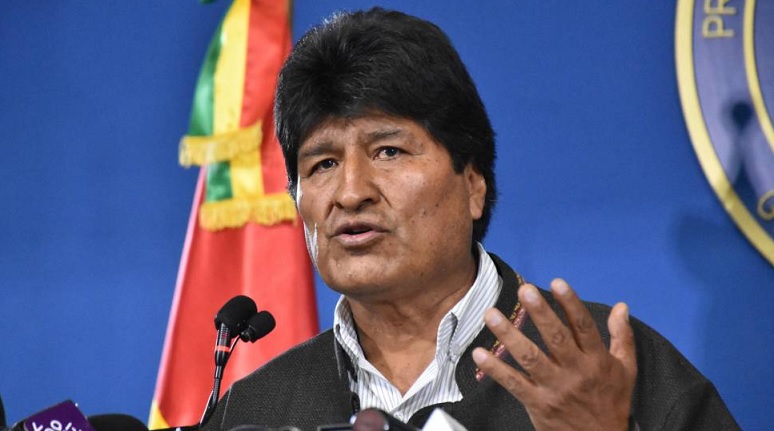
Acorralados por las protestas en su contra y abandonados por las fuerzas armadas, la policía e incluso por sus más cercanos colaboradores, el presidente de Bolivia, Evo Morales, y el vicepresidente, Álvaro García Linera, renunciaron este domingo a sus cargos.
Army Chief Williams Kaliman had asked for hours before his resignation: “After analysing the internal conflict situation, we suggest that the President of the State give up his presidential mandate, allowing peace and stability to be maintained for the sake of our Bolivia.”.
The former president, hiding in a coca-growing area in the centre of the country, reported on Sunday afternoon that the police are trying to arrest him with an illegal arrest warrant. The South American country is facing a power vacuum, following the resignation of the Presidents of the Chamber of Deputies and the Senate.
“It is my duty as the indigenous president and of all Bolivians to ensure social peace," the Bolivian President began his message of resignation. "I quit so that [Carlos] Mesa and [Luis Fernando] Camacho does not continue to abuse our fellow members” families, do not continue to attack ministers and deputies, so that they will stop mistreating the most humble," Morales said.
“The fight doesn't end here. The humble, the patriots, we will continue to fight for equality and peace.
I hope you understand my message; Mesa and Camacho, do not harm the poor, do not harm the people. We want social peace back. oligarchic groups conspired against democracy. It was a civic and police coup d'état. It hurts very much what has happened, ”he said.
After the resignation, unidentified elements but accused of being followers of the former man starred in several acts of vandalism in El Alto and in some neighborhoods of La Paz attacking shops, factories and caused a huge fire in a bus garage in the capital. A group of hooded-up women also took over the Venezuelan embassy in Bolivia, according to the France Presse agency. The mob has taken advantage of the absence of the police, which joined the demonstrations against the Government since Friday.
The atmosphere of chaos and discontrol has been denounced by Evo Morales on his social networks. "I report to the Bolivian world and people that a police officer publicly announced that he has an instruction to execute an illegal arrest warrant against my person; also, violent groups attacked my home. The coup-makers destroy the rule of law," the former President wrote.
This information has been denied by Vladimir Yuri Calderón, the national police commander, who said that the arrest warrant does not exist and that the whereabouts of the former is unknown.
In his resignation, the Vice President, Álvaro García Linera, had previously reported on the Government's economic and social achievements for almost 14 years. “We have raised Bolivia. On October 20, almost half of the Bolivians voted for us. From that moment on, strange and dark forces began to conspire. They burned down institutions and trade union headquarters.
They formed paramilitary gangs to intimidate the peasants, threatened our companions. It was a coup. I quit too. I have always been loyal to the president, I am proud to have been the vice president of an indigenous and will accompany him in good and bad, ”said the politician.
The opposition, led by the candidate and former President Carlos Mesa, wanted Morales and García Linera to refrain from participating in the new elections, as well as a plural agreement to choose a credible Electoral Tribunal.
Those responsible for the protests that convulsed the country considered that the renewal of the electoral body was insufficient and called for the renewal of all the powers of the State and the creation of a transitional “government board,” elected by the people of the uprising, to take over the new elections. The leader of the protests, Luis Fernando Camacho, asked this Sunday, following the resignation of the president, for the formation of a “government board” with the high military and police command.
The Bolivian president had already given up pressure on Sunday and announced new elections, after 18 days of protests calling for the annulment of the October 20 elections in which he was re-elected. All after the Organization of American States (OAS) issued an audit of the electoral process, it was ensured that the appropriate procedures were not followed and there were “strong” irregularities, and it required their annulment.
Following the OAS recommendation, Morales announced - in a late-morning television message - his intention to “renew all vocals of the Supreme Electoral Court.”.
The president insisted that his decision sought to “lower all tension” and “pacify Bolivia.” No apparent success. The Attorney General's Office announced an investigation on Sunday against the electoral court's vowels suspected of irregularities. The president of the organization, María Eugenia Choque Quispe, presented her resignation.
The police, who mutated two days ago and stopped acting in the protests to settle old accounts pending with the Government, which during its administration bowed in favour of the military, with whom the police have a historical rivalry.
A key factor in the situation for the protesters. During his term, Morales removed from the police institution some powers, such as the administration of the identification system, and preferred to rely on the armed forces that, however, did not want to defend him in this crisis.