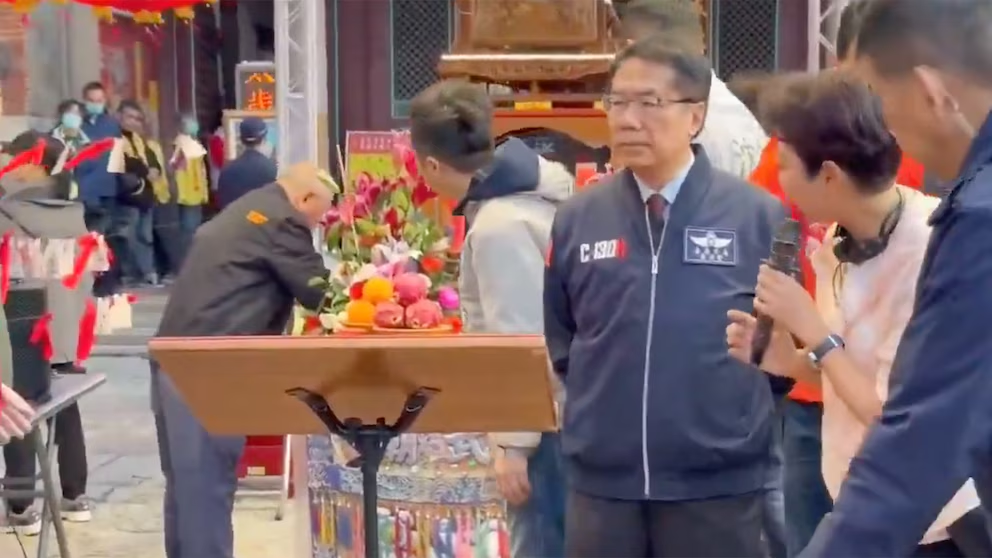
A protocolar act of the Lunar New Year in Taiwan became an unexpected situation last Wednesday when Lin Pei- huo, director of the historic Temple of the God of the Tainan War, puked over President Lai Ching- you during an official ceremony. The incident occurred as the president distributed red envelopes with symbolic money, an annual tradition made by Taiwanese political leaders during the celebrations of the new year on the lunar calendar.
Lin Pei-huo, who was standing next to the president on the line of local dignitaries, began to show visible signs of discomfort while the candidate for mayor Chen Ting-fei was speaking to the congregate faithful. Images of the event spread by Taiwanese media captured the moment when the temple director repeatedly blink, cling his fists and turning his head, obviously fighting the nausea.
You may be interested: Taiwanese President calls for opposition to China's "annexation" with "greater firmness"
Second, Lin raised a hand to his mouth but could not contain the vomit, which came out with force. Although he managed to cover part with the palm, some of the content fell on the shoulder and left arm of the president. The old leader staggered back, leaning on a nearby table as officials came to help.
Lai Ching- te, who was a doctor before entering politics, initially withdrew a few steps but then approached to attend Lin. According to local media reports, the president helped to direct the first aid measures at the site while the event was taking a short break. Lai then addressed the crowd gathered in the temple to explain that several members of Lin's family had recently contracted norovirus and that the temple director was probably also affected.
Lin Pei-huo apologized publicly to the attendees. “I'm so sorry, I couldn't help it,” he said before the event resumed. The president completed his participation in the ceremony while still wearing the stained sweater, being later filmed while distributing leaflets to the faithful.
The place, known as the only temple in Taiwan dedicated to the God of War that enjoyed official recognition during the Qing dynasty, is one of the oldest places of worship on the island. Built around 1665 during the Kingdom of Tungging, the temple venates Guan Gong, a general of the Han Dynasty that was deified as a symbol of righteousness and loyalty. In 1727, during the Qing reign, the temple received the status of “Sacred Rites,” an imperial designation that made it the most important martial religious center in Taiwan and gave it the responsibility to coordinate official ceremonies in spring and autumn.
The incident coincides with a significant outbreak of norovirus in Taiwan during the Lunar New Year festivities. According to data from the Taiwan Disease Control Centres published on Thursday, over 7,500 people sought medical care for diarrhoea during the first three days of the celebrations, with almost 90% of the group outbreaks caused by norovirus. The virus, known as the “winter vomiting virus,” is highly contagious and typically causes vomiting and diarrhoea that last between 24 and 72 hours.
The tradition of political leaders distributing red envelopes during the Lunar New Year is deeply rooted in Taiwanese culture. These envelopes, called hongbao, contain small amounts of money and are delivered in temples, markets and community events as a gesture of good wishes for the coming year. The Lunar New Year of 2026, which marks the beginning of the Year of the Horse, began on February 17 and is the most important holiday of the Taiwanese calendar, with celebrations that extend for several days and include visits to temples, family meetings and the exchange of red envelopes between relatives.