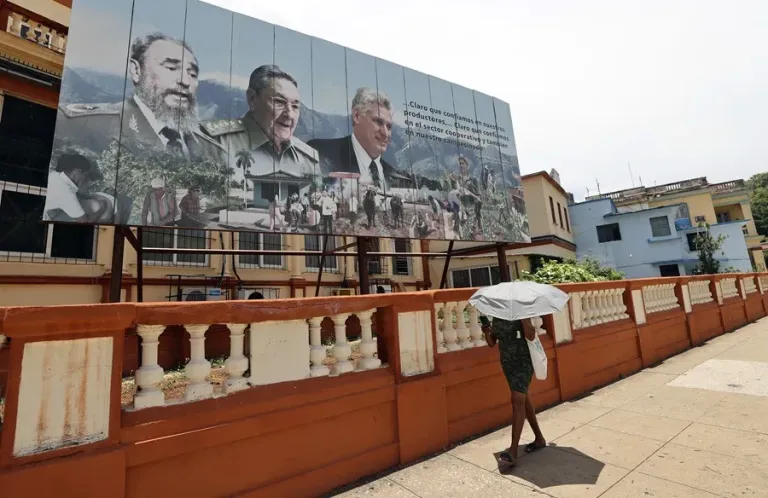
La Habana.- Cuba's President Miguel Diaz- Canel advanced several economic measures that seek to adapt the country, in a deep crisis, to «the demands of the present times,» an announcement that this Saturday found divergent positions among Cubans. «Get out of this» What do reforms bring?
In a surprise and only to state media, Diaz- Canel reported on the day before on reforms that include changes to decentralize and allocate greater «autonomy» to state companies, to provinces and municipalities, as well as changes in tourism, foreign trade, foreign investment and the private sector.
“It seems to me that these measures have already been mentioned on other occasions. I don't know why they sound even familiar and that they had not been implemented in the end? That they were things that have been left, and like now it's already a desperate thing,” he told EFE Maydolis Oliva.
This 39-year-old habanera, which was walking through the municipality Playa, loaded with household commodities such as cooking oil and toilet, said it was unreliable that the measures had arrived at a time of compulsory definition for the country.
We recommend reading: A 59 % of Cuba will be both without current on Saturday due to the energy crisis
“It has already come as a top in which they have to do it; and that it will not solve anything at this point in life,” he concluded.
Although the Cuban Government did not link the reforms this Friday to the negotiation with the United States, Washington does press Havana to introduce economic and political reforms. He said, “It is time to change and the country cannot continue to function the same.».
«Get out of this.»
Referring to the current context of the island, Diaz@-@ Canel said that “the country is not in detention” and faces “with intelligence this whole situation,” in reference to the serious energy crisis that Cuba has been experiencing since mid-2024, aggravated since January by the US oil siege to what has been added since May, reinforced sanctions against vital sectors of the economy.
On the island, the blackouts that reach the two consecutive days in almost all the provinces and more than 20 hours followed daily in Havana have increased, which has caused social discontent, and peaceful protests, street-burning and caches take place every day.
One of the measures announced this Friday, seeks to encourage the island to be “less and less dependent on the electricity generation with the use of fossil fuels, especially by the US blockade, by which in“ the last five months nothing more has entered a ship of oil to Cuba, ”Diaz@-@ Canel added.
“He (Diaz@-@ Canel) spoke of the food program, of opening up the investments, and was going to remove some obstacles and I think they are just things, he commented more hopeful to EFE, Diosdado Liquor, a 65-year-old retired man.
While talking about the measures with another neighbor on Avenida 3rd of the Havana district of Miramar, one of the most well-known parts of the capital, Liquor said: «I think what is there is to follow and follow the law (...) I think we are going to get out of this.».
«We Cubans have to get out of this, if we've come up with worse things,” he said.
What do reforms bring?
The broad package of economic reforms released on Friday includes, among other things, increasing the «autonomy» of state-owned enterprises in terms of wages, profit investment (profits), import and export and association with other economic actors.
You can also read: Cuba receives a donation of 1,700 tons of commodities from Mexico and Belize
It is also planned to eliminate the importers, state-owned companies that mediate foreign trade, the end of the restrictions on the import of vehicles; and the entry of «new actors» into the tourism sector, to «exploit» the island's hotel park following the recent total or partial withdrawal of foreign hotels in order to avoid US sanctions.
In addition, it is envisaged to «encourage» foreign direct investment, taking into account the role that Cubans living abroad could play, which will have the same conditions as their fellow nationals on the island.
All these changes will be presented for approval at the National Assembly of People's Power (ANPP, a unicameral parliament) at its session next July.