São Paul.- The outcome of the presidential elections in Brazil will give a final shape to the political map of Latin America. The country is the last piece of the «blue tide» sponsored by Donald Trump and at the same time the nail burning from a falling layer progressivity in the region.
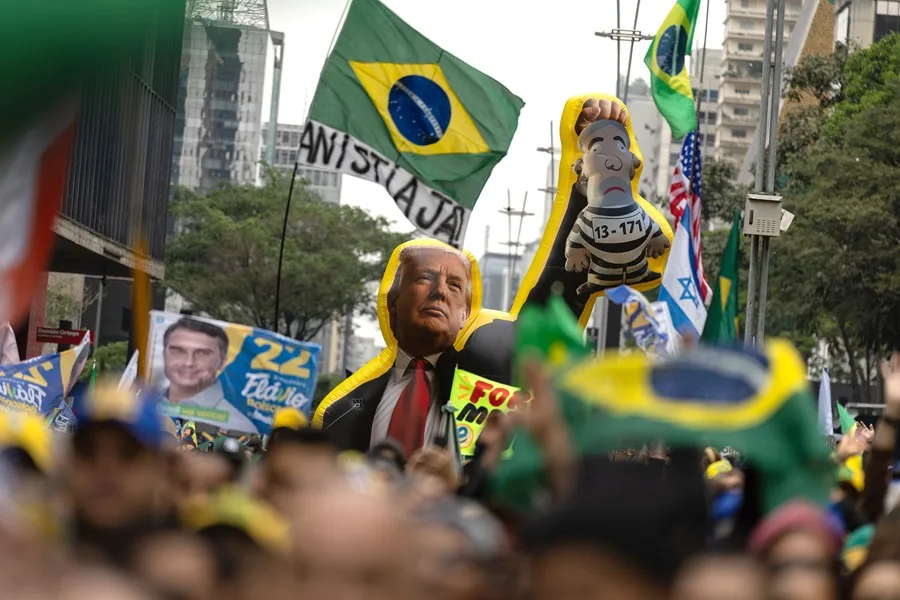
The two favorites for the elections on Sunday, October 4 represent different paths: President Luiz Inácio Lula da Silva, in search of his fourth term at his 80s, and Senator Flávio Bolsonaro, son of former president Ultraderectist Jair Bolsonaro.
A highly polarized and key campaign in geopolitical terms, in full ascension of the radical right not only in America, but also in Europe and in Asian countries like Japan.
In this context, Brazil had not experienced such obvious attempts at external interference in its recent history during its electoral process, according to experts consulted by EFE.
Photo by the President of Brazil and candidate for re-election, Luiz Inácio Lula da Silva, speaking during the UN General Assembly on September 22, in New York, USA. EEF / EPA / Olga Fedorova
Lula denounced it in the United Nations General Assembly: «Democracy is again in check. We again witness external interference in electoral processes (in Latin America).».
Trump and Milei, in campaign
The United States and Argentina have led these attempts to interfere with actions that have sought «to destabilize» the Lula Government, says EFE Marília Pimenta, a doctor in international relations and professor at the State University Paulista Júlio de Mesquita Filho (Unesp).
In July, Argentine President Javier Milei travelled to São Paulo to publicly support Flávio Bolsonaro and insult Lula, whom he called «thief» and «prisoner.».
In response, Brazil reduced the relationship with its great South American partner. The crisis is still open.
Archive photo by the President of Argentina, Javier Milei (i), together with Brazilian presidential candidate and senator Flávio Bolsonaro (d), in São Paulo, Brazil. EEF / Isaac Fontana
The 25 % and 12.5 % tariffs imposed by the Trump Administration for alleged «discriminatory» practices and the use of forced labour are also perceived as a way of «wasting» Lula at the door of the elections.
The United States also tried to send a comment to verify the adequacy of the Brazilian electoral process and visit Jair Bolsonaro, convicted of beating and home imprisonment.
He also pushed the Executive to give the credentials to his new ambassador in the country. Lula announced that she will only analyze it after the elections, to which Trump responded by withdrawing the visa to the Brazilian ambassador in Washington.
Photo by U.S. President Donald Trump at the White House Oval Office in Washington, USA. EFE / EPA / Aaron Schwartz
In parallel, trade negotiations between the two largest democracies in America continue, with the anticipation of a meeting on the margins of the G20 Ministerial Trade Summit to be held this week in Milwaukee.
The Shield of the Americas, to debate
As a backdrop is the new lace of Latin America with the United States, Lula has always been committed to regional integration without the presence of the American power. This was done with the forgotten Unasur and in her current mandate with the Brasilia Consensus.
But in these four years Argentina, Bolivia, Colombia, Peru and Chile, among others, have changed color, giving way to a «blue tide» that today dominates a large part of the governments of the region.
These countries and others, such as Ecuador, Paraguay, El Salvador and Honduras - all governed by the right - have joined the so-called ‘Escudo de las Americas’, an initiative promoted by Trump with the aim of combating drug trafficking, but not just that.
Photo of the special envoy for the Shield, March 7, 2026, Kristi Noem (2-i), together with the US Secretary of State, Marco Rubio (c), at a meeting of the ‘Shield of the Americas’ Summit in Miami (USA). EFE / Alberto Boal
After its last meeting, outside the UN Assembly, they also agreed to take action to «explore investment control mechanisms»; «safeguard critical mineral supply chains» and «promote rules on trusted providers for digital infrastructure.».
Brazil «never» has been invited to join the group, government sources are assured of it as a mechanism aligned with the «Trump Government's national security doctrine,» that is, with the new version of the ‘America for Americans’.
These same sources believe that it opens the door to possible U.S. military interventions and that it is in fact seeking to subtract China's growing influence on the continent.
The effect of a possible Bolsonaro triumph
Flavio Bolsonaro, tied with Lula in the polls, has already anticipated that he will join the Shield if he wins the elections.
For Pimenta, Bolsonaro's eventual victory will «open the country» to US companies for the exploitation of critical minerals and water resources for data centres.
From the government, they point out to EFE that «there would be no way to accept something in that regard.».
In public, Lula enarbola has national sovereignty and calls for cooperation with the United States on security, but refuses to have aircraft carriers watching its coastline.