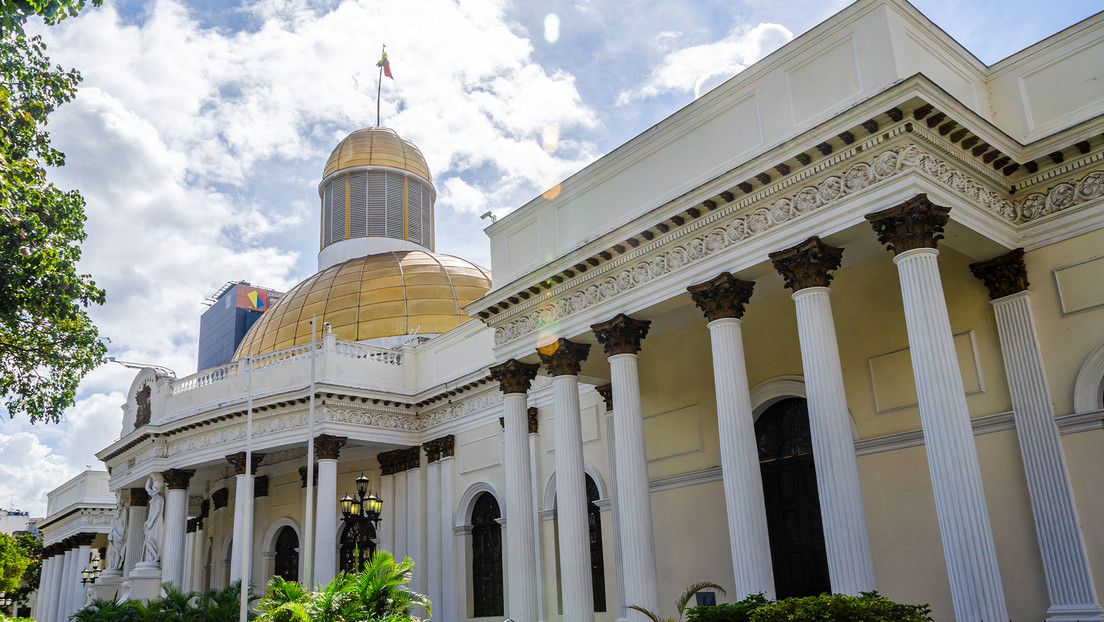
The National Assembly (AN) of Venezuela unanimously adopted the Amnesty Law on Democratic Coexistence, proposed by the President-in-Charge, Delcy Rodríguez.
In accordance with the provisions of local laws, the legislative initiative was submitted to public consultation between different sectors of Venezuelan society, after obtaining a green light in its first discussion, which allowed for the addition of matters not initially considered, as well as the clarification of aspects that brought ambiguity.
Te puede interesar: http://Venezuela llama "locura imperial" que RD autorice a EEUU a utilizar aeropuertos
De conformidad con la exposición de motivos, esta normativa "busca la convivencia y la paz entre los venezolanos" para que se logre una "coexistencia desde la diversidad y la pluralidad […] con respeto a la ley y a la justicia", en el entendido de que le corresponde al Poder Legislativo "dictar medidas" de reparación para atender las "heridas profundas" que existen en la sociedad venezolana, producto de "la confrontación política desde el extremismo".
The legal text is based on values such as respect for "life, freedom, justice, equality, solidarity, democracy, social responsibility, human rights, ethics and political pluralism," which are part of the "democratic and social state of law and justice.".
It also provides "clear safeguards" on crimes that will be excluded from the legal instrument, namely, "serious human rights violations, crimes against humanity, war crimes, intentional murder, corruption and drug trafficking.".
Prior to its approval, the Venezuelan Government reported that between November 2025 and the beginning of this month 896 persons have been released, arrested for allegedly committing crimes related to political violence or after being found guilty of such actions.
The main points of the law
The document states that the purpose of the instrument is to "grant a general and full amnesty" to persons "who are prosecuted or convicted for the alleged or proven commission of political or related offences, from 1 January 1999 to 30 January 2026.".
The facts that are taken into account in this period are:
State coup of 11 April 2002, including assaults and attacks on government, mayors and public and private facilities.
The political violence in the context of the business and oil unemployment and sabotage from December 2002 to February 2003.
The political-motivated violence in February and March and August 2004; in May 2007; following the 2013 presidential elections; in February and June 2014; in March and August 2017; in January and April 2019; and in the July 2024 presidential elections.
With the approval of the law, the police, the investigation bodies and the military "will complete the investigations and procedures concerning the facts" referred to. Similarly, files on processes open to amnistiated people should be deleted.
The National Executive will be responsible for developing and implementing mechanisms to ensure compliance with the legal regulations. As a first step, a special commission was established, consisting of 23 parliamentarians from all political groups, who will follow up on the implementation of the amnesty.
A presidential petition
On 23 January, the President-in-Charge announced the creation of the Programme for Democratic Coexistence and Peace, which in its first hundred days aims to develop a national plan "aimed at consolidating the country's tranquility in all its dimensions.".
Days later, Rodríguez revealed that he would promote an amnesty law that would cover the political period between 1999, when President Hugo Chávez first took up his inauguration, to the present.
Previously, the President of the AN, Jorge Rodríguez, said that the "Bolivarian forces" made an "initial contribution" to the "beginning of the national dialogue" between the different sectors of the political, economic, cultural and social life of the country.
"What we would like is for this law to give a powerful, powerful message of the intention of a new political moment, which also will rapidly enhance dialogue," he said.