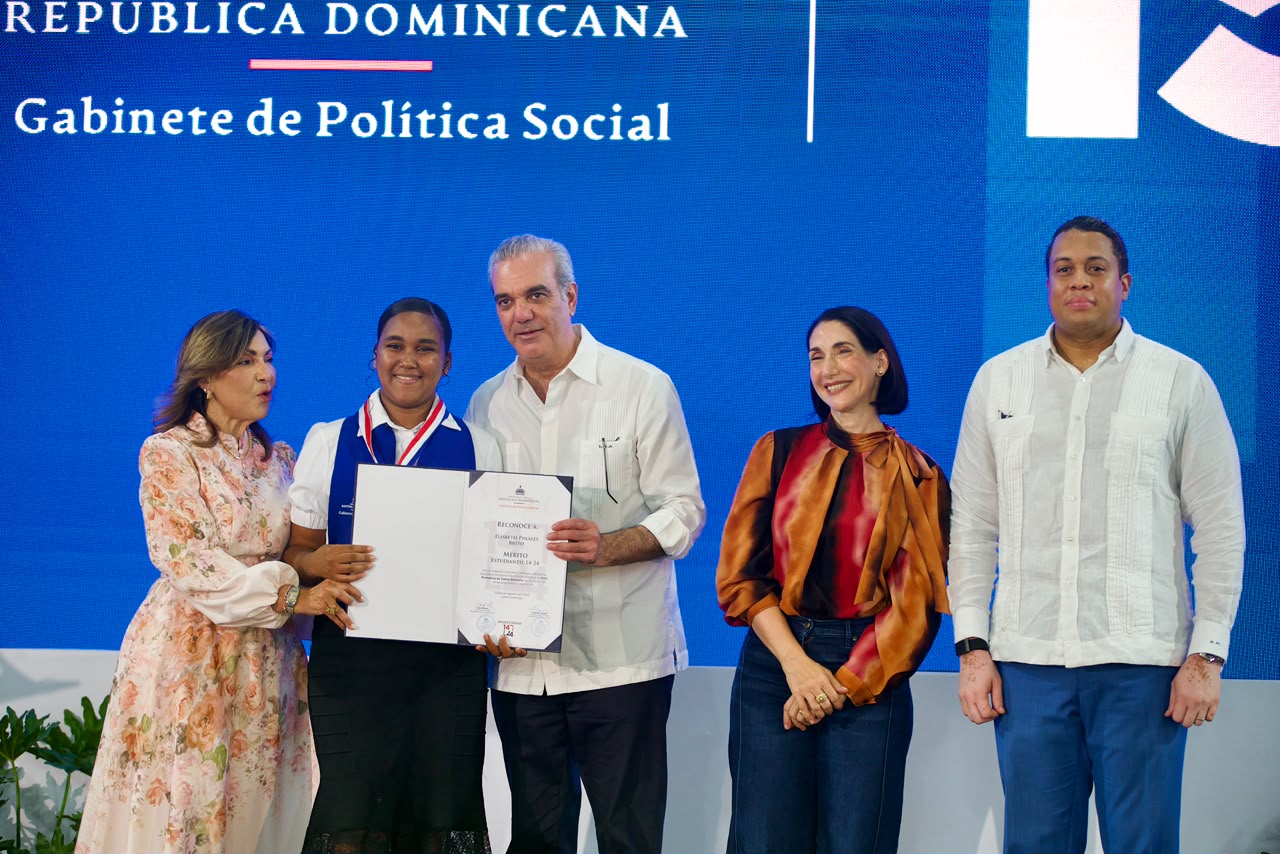
Santo Doming.- President Luis Abinader, accompanied by the first lady, Raquel Arbaje, and the coordinator of the Social Policy Cabinet, Geanilda Vásquez, led the fifteenth regular graduation of the Opportunity 14-24 program on Saturday, in which 2,576 young people completed their technical training during the first half of 2026.
With this new promotion, the programme has exceeded 35 thousand graduates since its launch, while more than 69 thousand young people have been benefited by the initiative.
The ceremony was attended by the Metropolitan and East regions and brought together young people from 10 provinces and the National District.
During the event, Vásquez stressed that Opportunity 14-24 seeks to provide young people with tools that enable them to develop their skills, access to jobs, undertake business or return to the education system.
“A truly transformative social policy must be able to turn protection into opportunity; opportunity into autonomy; and autonomy into social mobility,” he said.
The official explained that the results of the programme are part of a broader social policy strategy based on coordination between institutions, services and opportunities to meet the needs of the population.
In this regard, he indicated that 283 days of social inclusion were held during 2025, with more than 135 thousand people receiving health, food, medicine, counselling and social protection services.
He also reported that Punto Solidario attended more than 197 thousand citizens and recorded more than 327 thousand consultations during that period.
The young graduates were trained in different technical-professional areas, including beauty, hotel, accounting, residential electricity, gastronomy, computer, English, multimedia, bakery and pastry, hairdresser, pharmaceutical promotion, hotel reception, secretariat, food and drink services, technical support, sales and management of forklifts.
As part of the accompaniment to the participants, Opportunity 14-24 also develops the School Derivation Strategy, in coordination with the Ministry of Education, to identify young people who have left their studies and to facilitate their return to the classrooms through programmes such as PREPARA.
In 2026, the programme has 149 training spaces distributed in the 31 provinces and the National District, expanding its scope to provide more young people with opportunities for training and access to better living conditions.